How to Evaluate SaaS Pricing Models (Enterprise Framework Guide)
Executive Summary
Evaluating SaaS pricing is not about comparing monthly fees. It is about understanding value capture, scalability risk, long-term cost structure, and alignment with your growth model.
Most organizations focus on headline pricing (e.g., $49/user/month). Enterprise buyers evaluate:
- Total Cost of Ownership (TCO)
- Cost predictability under growth scenarios
- Value-based pricing alignment
- Contractual flexibility
- Expansion risk
- Exit friction
This guide provides a structured framework used by high-level procurement and growth teams to evaluate SaaS pricing models strategically — not emotionally.
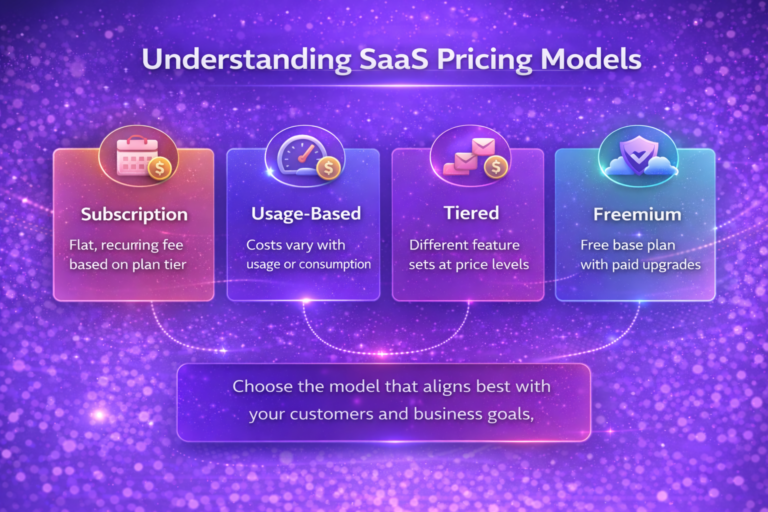
1. Understand the Core SaaS Pricing Models
Before evaluating, you must classify the model.
1️⃣ Per-User Pricing
You pay per active user per month.
Best for:
- Teams with stable headcount
- Clear seat-based workflows
Risks:
- Penalizes growth
- Encourages credential sharing
- Cost explodes with scale
Enterprise Question:
Does pricing scale linearly while value scales exponentially?
2️⃣ Usage-Based Pricing
You pay based on API calls, storage, transactions, or volume.
Best for:
- Data-heavy operations
- Elastic workloads
Risks:
- Cost unpredictability
- Budget volatility
- Hard forecasting
Enterprise Question:
Can finance model 12–24 month projections confidently?
3️⃣ Tiered Pricing
Bundled features across tiers (Basic, Pro, Enterprise).
Best for:
- Feature segmentation
- Clear upgrade path
Risks:
- Artificial feature gating
- Forced upgrades
- Paying for unused capabilities
Enterprise Question:
Are we upgrading for value — or unlocking artificially restricted functionality?
4️⃣ Value-Based Pricing
Pricing tied to measurable business outcomes.
Best for:
- Revenue-generating tools
- Performance platforms
Risks:
- Vendor-defined “value”
- Opaque pricing logic
Enterprise Question:
Is value independently measurable or vendor-claimed?
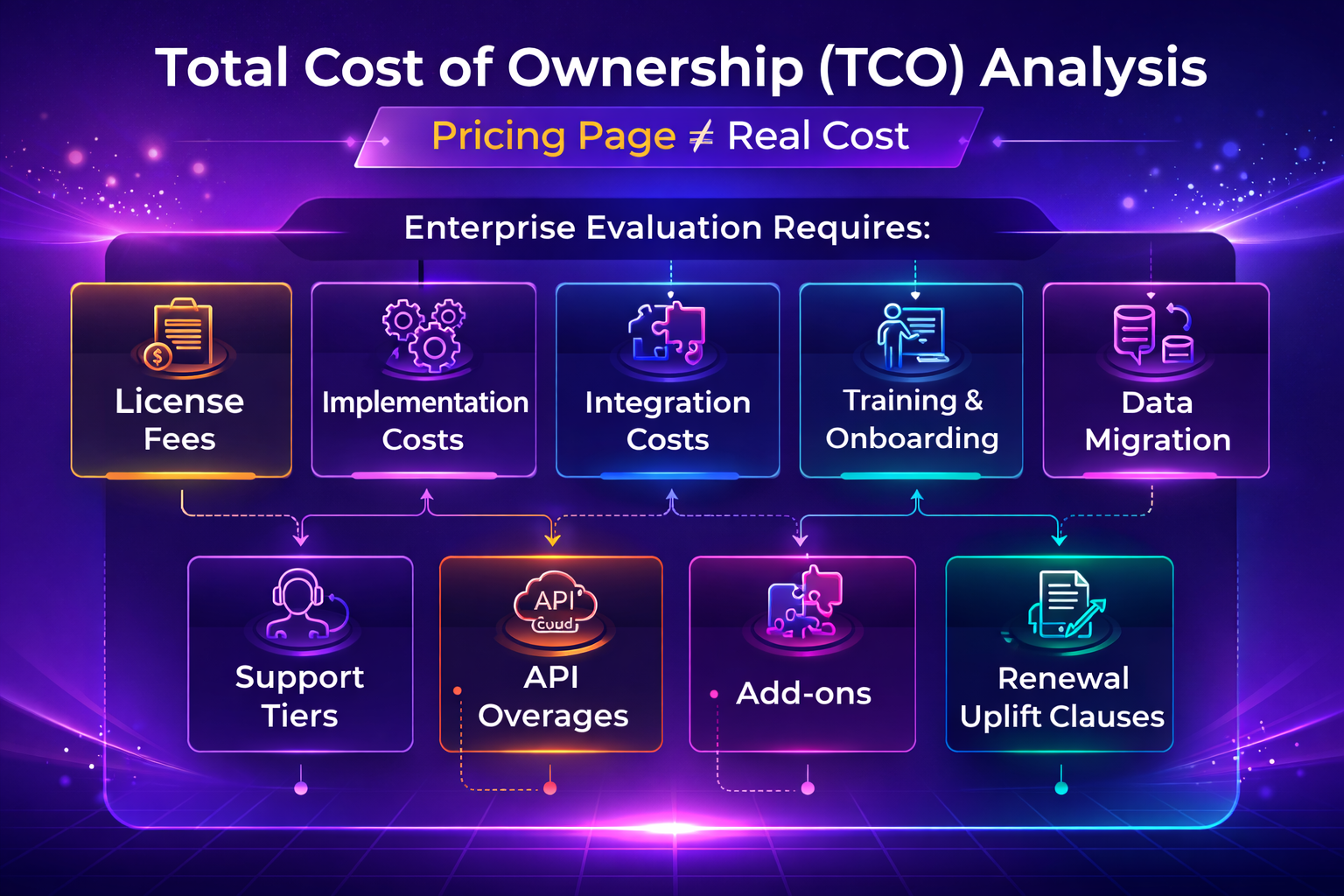
2. Total Cost of Ownership (TCO) Analysis
Pricing page ≠ Real cost.
Enterprise evaluation requires:
- License fees
- Implementation costs
- Integration costs
- Training
- Onboarding
- Data migration
- Support tiers
- API overages
- Add-ons
- Renewal uplift clauses
Formula Framework:
**TCO = (Base Subscription + Add-ons + Overages) × Contract Term
- Implementation Costs
- Internal Operational Costs**
If TCO modeling is not done before signing, expect margin erosion later.
3. Growth Scenario Stress Testing
Never evaluate SaaS pricing based on your current size.
Model:
- 2× user growth
- 3× data growth
- Geographic expansion
- Multi-team adoption
Ask:
- Does pricing compound?
- Does discounting hold at renewal?
- Are enterprise thresholds hidden?
A model that looks affordable at 10 users can become structurally inefficient at 150.
4. Marginal Cost vs Marginal Value
High-level evaluation asks:
Does marginal cost increase slower than marginal value?
If:
- Each new user increases cost proportionally
- But value does not increase proportionally
You are in a negative leverage structure.
Elite SaaS pricing allows:
- High operating leverage
- Predictable scaling
- Non-linear ROI expansion
5. Contractual Risk Assessment
Enterprise-level buyers examine:
- Auto-renewal clauses
- Price increase caps
- Multi-year discount traps
- Early termination penalties
- Data ownership and export rights
Low monthly price + high exit friction = hidden cost.
6. Unit Economics Perspective
From a CFO lens, evaluate:
- CAC impact
- LTV expansion potential
- Payback period
- Gross margin implications
If a SaaS tool:
- Increases revenue efficiency
- Reduces headcount dependency
- Automates cost centers
Then pricing must be evaluated against contribution margin — not subscription cost.
7. Pricing Red Flags
Be cautious if you see:
- Opaque enterprise pricing
- Mandatory feature bundling
- Extreme jump between tiers
- Heavy overage penalties
- No transparent API limits
- Forced annual lock-in
Pricing opacity often signals aggressive revenue extraction.
8. Enterprise Evaluation Checklist
Before signing any SaaS contract, confirm:
☑ Modeled 24-month TCO
☑ Stress-tested growth scenarios
☑ Reviewed renewal uplift clauses
☑ Verified API and usage caps
☑ Evaluated switching cost
☑ Benchmarked 2–3 competitors
☑ Negotiated enterprise discount
☑ Confirmed data portability
Strategic Positioning Insight
The strongest SaaS vendors align pricing with customer expansion. The weakest vendors monetize dependency.
Your goal is not to find the cheapest tool.
Your goal is to secure:
- Predictable scaling
- Positive operating leverage
- Contractual flexibility
- Clear ROI pathway
Enterprise SaaS decisions are capital allocation decisions — not software purchases.
Final Framework Summary
To evaluate SaaS pricing models properly:
- Classify the pricing model
- Calculate full TCO
- Stress-test scaling
- Evaluate marginal cost curve
- Assess contract risk
- Model ROI impact
- Negotiate aggressively
If pricing cannot withstand structured scrutiny, it is not enterprise-ready.