SaaS Scalability Guide for Growing Businesses
Growth exposes weaknesses. What works at 20 users often breaks at 200.
Scalability in SaaS is not just about handling more users — it is about sustaining performance, cost efficiency, security, and operational control as complexity increases.
This guide provides an enterprise-level framework to evaluate SaaS scalability before your growth becomes a liability.
What Is SaaS Scalability?
SaaS scalability refers to a platform’s ability to:
- Handle increasing users, data, and transactions
- Maintain performance under load
- Preserve predictable cost structures
- Support multi-team or multi-region expansion
- Integrate with expanding tech stacks
True scalability balances technical elasticity + financial sustainability + governance control.
1. Architectural Scalability
Before scaling with any SaaS platform, evaluate its infrastructure model.
Key Questions:
- Is the system cloud-native or legacy hosted?
- Does it use horizontal scaling (auto-scaling servers)?
- How does it handle traffic spikes?
- Are uptime SLAs clearly defined?
- Is redundancy built-in?
Look for:
- Multi-region infrastructure
- Documented uptime history (99.9%+ SLA)
- Public status dashboards
- API-first architecture
If architecture is opaque, scalability risk is high.
2. Performance Under Load
Growth increases:
- Concurrent users
- Data storage
- API requests
- Automation workflows
Evaluate:
- Load testing benchmarks
- API rate limits
- Data processing limits
- Real-world enterprise case studies
If performance degrades as usage rises, operational efficiency collapses.
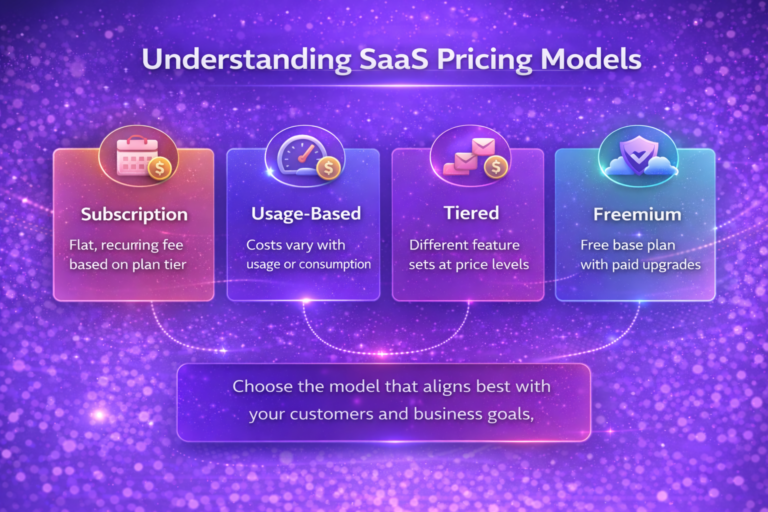
3. SaaS Pricing Scalability
Many SaaS platforms scale technically but not financially.
Analyze:
- Per-user cost growth curve
- Usage-based pricing volatility
- Tier upgrade thresholds
- Enterprise contract flexibility
- Volume discount availability
Model 12–24 month growth projections before committing.
If pricing scales linearly while value plateaus, margins erode.
4. Integration & Ecosystem Scalability
Growing businesses expand their tech stack.
Assess:
- Native integrations
- Webhooks & automation support
- API documentation depth
- Middleware compatibility (Zapier, custom integrations, etc.)
- Data export flexibility
Closed ecosystems create long-term dependency risk.
5. Security & Compliance at Scale
As your business grows, regulatory exposure increases.
Evaluate:
- SOC 2 compliance
- GDPR readiness
- Role-based access control (RBAC)
- Audit logs
- Data encryption standards
- SSO & identity management support
Security scalability is often ignored until an incident occurs.
6. Operational Scalability
Beyond infrastructure, ask:
- Can multiple teams collaborate efficiently?
- Are permission hierarchies flexible?
- Does the system support workflows across departments?
- Is reporting customizable for different stakeholders?
If operations become fragmented, productivity declines.
7. Vendor Risk & Long-Term Viability
Scaling with a vendor creates dependency.
Evaluate:
- Financial stability
- Funding stage
- Customer concentration risk
- Churn indicators
- Product roadmap transparency
Vendor instability can disrupt your entire operational infrastructure.
8. SaaS Scalability Checklist for Growing Businesses
Before committing to long-term contracts:
☑ Verified infrastructure elasticity
☑ Reviewed API limits
☑ Modeled 24-month cost projections
☑ Tested performance under load
☑ Assessed security compliance
☑ Confirmed integration flexibility
☑ Negotiated enterprise pricing terms
☑ Ensured data portability
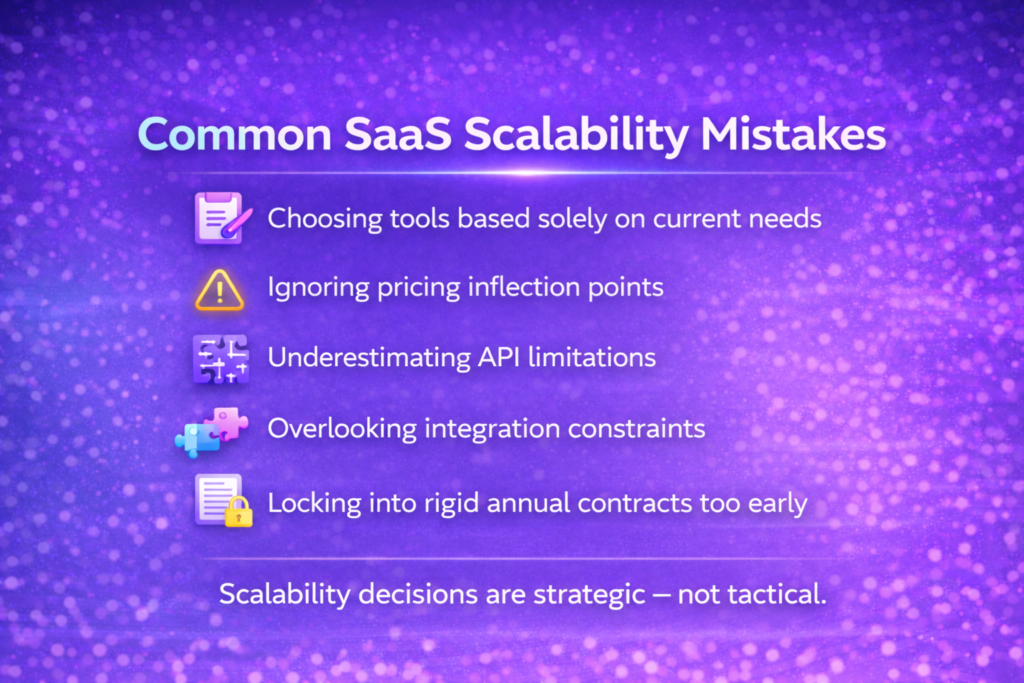
Common SaaS Scalability Mistakes
- Choosing tools based solely on current needs
- Ignoring pricing inflection points
- Underestimating API limitations
- Overlooking integration constraints
- Locking into rigid annual contracts too early
Scalability decisions are strategic — not tactical.
Strategic Framework: Scalability as Competitive Advantage
Scalable SaaS platforms enable:
- Faster expansion
- Higher operational leverage
- Reduced headcount dependency
- Predictable margin growth
Non-scalable tools introduce friction, cost volatility, and risk concentration.
The goal is not just growth — it is controlled, sustainable growth.